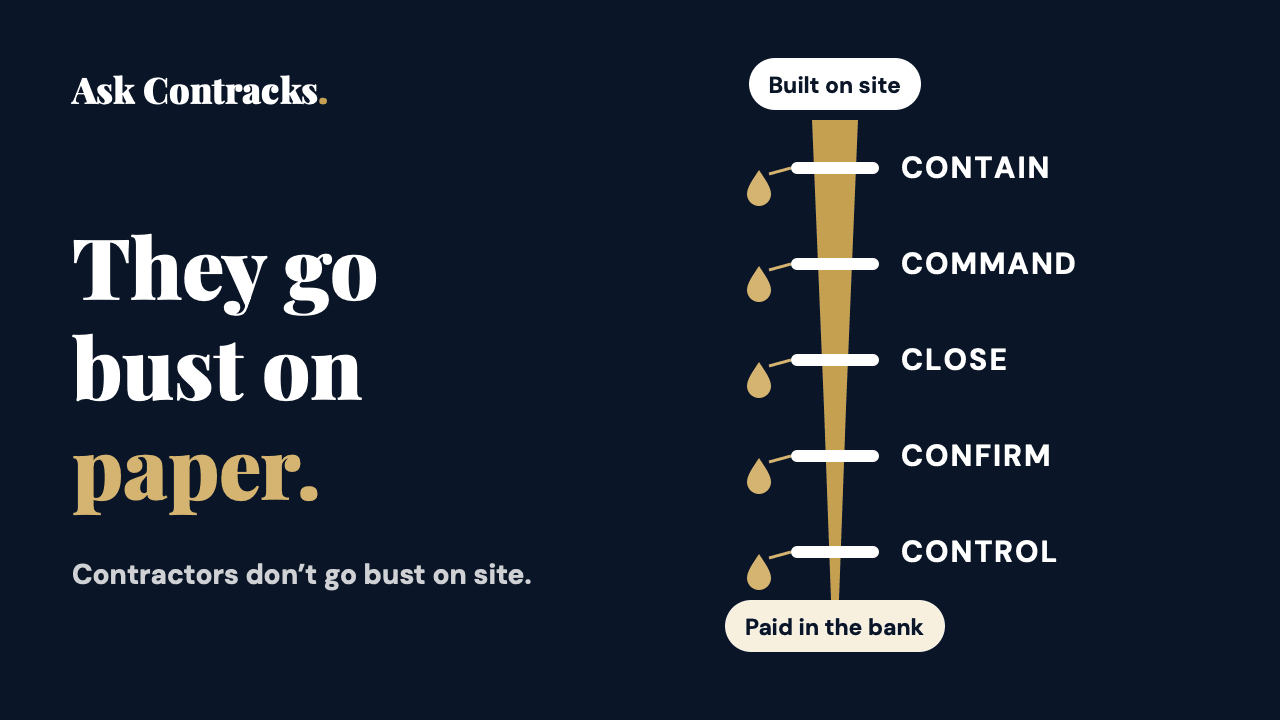
The job went well. So where did the margin go?
The project is nearly finished. The client is happy. The quality is good. Your people worked hard.
Then the final account lands on your desk — and the margin isn’t there.
Nobody stole it. Nothing collapsed. It left quietly, one piece of paper at a time.
- A change agreed on site, built, and never priced.
- A notice that went out a week late.
- A payment cut that nobody challenged in writing.
Not every loss starts in the paperwork. But too many losses become permanent because nobody was controlling the contract while the work was being done.
It’s the fear nobody says out loud on site: finishing a project you built well — and losing money on it. Or losing the company.
You built it. You should get paid for it.
Contractors don’t go bust on site. They go bust on paper.
“We build well, so we’ll get paid.”
Most good builders carry that belief. It feels right. Quality is what you control. It’s what you’re proud of. It’s why clients call you back.
Good work earns trust. Getting paid what the contract owes you also takes proof: showing your entitlement, following the agreed procedure, and doing it before the deadline passes.
Two contractors can build the same job to the same standard and finish with very different margins. The difference isn’t on site.
Here’s the blind spot. Site problems are loud. A crane goes down and your phone rings within a minute.
Paper problems are silent. A missed notice makes no noise. An unpriced change sends no alert. You find out months later, at the final account — when it’s expensive, and the people who remember have moved on.
Five places the money leaks — and the control for each
On a live contract, money leaks in five places. None of them looks dramatic on its own. One unpriced change doesn’t feel like a loss. A year of them does.
A contract is a system of control, and the controls for these leaks are what we call the 5Cs Framework™. Here’s each one, with the one question that tells you where you stand.
A change is agreed on site, by phone or on WhatsApp. Your team builds it. You pay for the labour and the materials. Nobody prices it. Built it, never billed it.
The question: Can you list this month’s changes, and say which ones are priced?
The programme slips a week here, a week there. You absorb it, because nobody has time to record why. Then the client’s claim lands on a Friday, and your answer has to be rebuilt from memory. Strong claims are built on contemporaneous records — not reconstructed under pressure.
The question: If a delay claim landed this Friday, could you show what happened, week by week?
An instruction stays verbal. A client decision stays open. Your team keeps building on an assumption. Months later, it’s your memory against theirs.
The question: Which instructions and decisions are still open, who owns each one, and when must it be closed?
Applied, certified, paid: three different numbers. A cut nobody challenges in writing quietly becomes the new baseline. Your final account starts from there.
The question: Can you reconcile what you applied for, what was certified and what was paid, and explain every difference?
The contract is tracked in someone’s head. That works until they’re on leave, on another job, or simply too busy. Under the standard FIDIC 1999 forms, Sub-Clause 20.1 generally requires your claim notice within 28 days of when you became aware of the event, or should have. The 2017 forms keep a 28-day Notice of Claim under Sub-Clause 20.2.1, with added procedures for late notices. Miss the deadline, and an otherwise valid entitlement is at risk. Editions, particular conditions and governing law change the consequences of a late notice — so check your contract’s own clause.
The question: Which notice deadlines fall in the next two weeks, and who owns each one?
The five feed each other. An unconfirmed instruction becomes an unpriced change. An unpriced change never reaches your payment application. A delay nobody recorded leaves you exposed when the claim arrives. And a missed deadline can close the door on all of it.
That’s why fixing one is rarely enough, and why good people, working hard on the wrong day, still lose money. Effort has little to do with it. It comes down to who has the time to look, and when.
If you have no contract team
The contract falls on your project manager. At 11pm.
After the site, the client, the subcontractors and the programme, the paperwork gets whatever is left of the day. So today’s letter gets written, and last week’s variation waits.
Your project manager hasn’t failed. Nobody was given the time to do this job. And it costs you twice: once in money you don’t recover, again in a good manager running on empty.
You don’t need a department to start. You need one list, one owner and one fixed hour a week. On that list: every deadline, every open instruction, every unpriced change, every payment gap.
If you already have an experienced team
Strong teams lose entitlement too, just in different months.
In a peak month, everyone moves to the urgent. A big claim. A handover. A difficult negotiation. Your best people go to the biggest fire.
Meanwhile the smaller things keep passing: the notice on a smaller package, the cut on an interim payment. Nobody dropped the ball. There were more balls than hands.
Your team can do the work. In those months there’s just too much of it. What helps then is more senior hands, and an independent view from outside the fire. And when someone goes on leave or moves on, what they were tracking should not leave with them.
We don’t replace your team’s judgement. We reinforce it.
One contract. One hour. This week.
You can test all of this before Friday.
- Block 60 minutes. Pick your most exposed live contract, and bring whoever knows it best.
- Ask the five questions above. “I don’t know” counts as a no.
- Put every no on one page: the item, one owner, one date.
- Deal with anything time-critical first, and check any notice date against your contract’s own clause today.
- Book the same hour next week.
That weekly hour is our recommended discipline, not a contractual deadline.
“Our client relationship is good. We don’t need the paperwork.”
I hear you. Good relationships are worth protecting.
But the person who agreed the change on site isn’t always the person who signs the final account. Projects run for years. People move on. Memory fades.
And a written confirmation is a courtesy: this is what we agreed — tell me if I’ve got it wrong. That’s an easy email to send while everyone is friendly. It’s a much harder conversation later.
The same goes for “we’ll sort it at final account.” By then the facts are old, the people may have gone, and every unchallenged cut has become the starting point.
Good paper gives a good relationship something to stand on.
What I have seen it do
Founder experience, before Ask Contracks — not results delivered by Ask Contracks.
As contract and commercial lead: six months of programme time lost to idle time recovered within the original programme window, and a €30M+ claims position maintained.
I led the commercial negotiation: a stalled FIDIC negotiation unlocked, and the relationship kept.
Your contract, your law and your facts will differ. The lesson I took from both holds: the site work earns the money, and the paper gets it to the bank.
The best builders should win — not just the best contract fighters.
Find out where your paper is weakest
Fixing all five can wait. First find out which one is leaking most.
The Contract Score takes four minutes. It scores the same five controls and shows your two biggest gaps.
Get my Contract Score — free →
General information, not legal advice.
Next article — 16 November: The 28-day clock: how a missed notice can put your claim at risk.