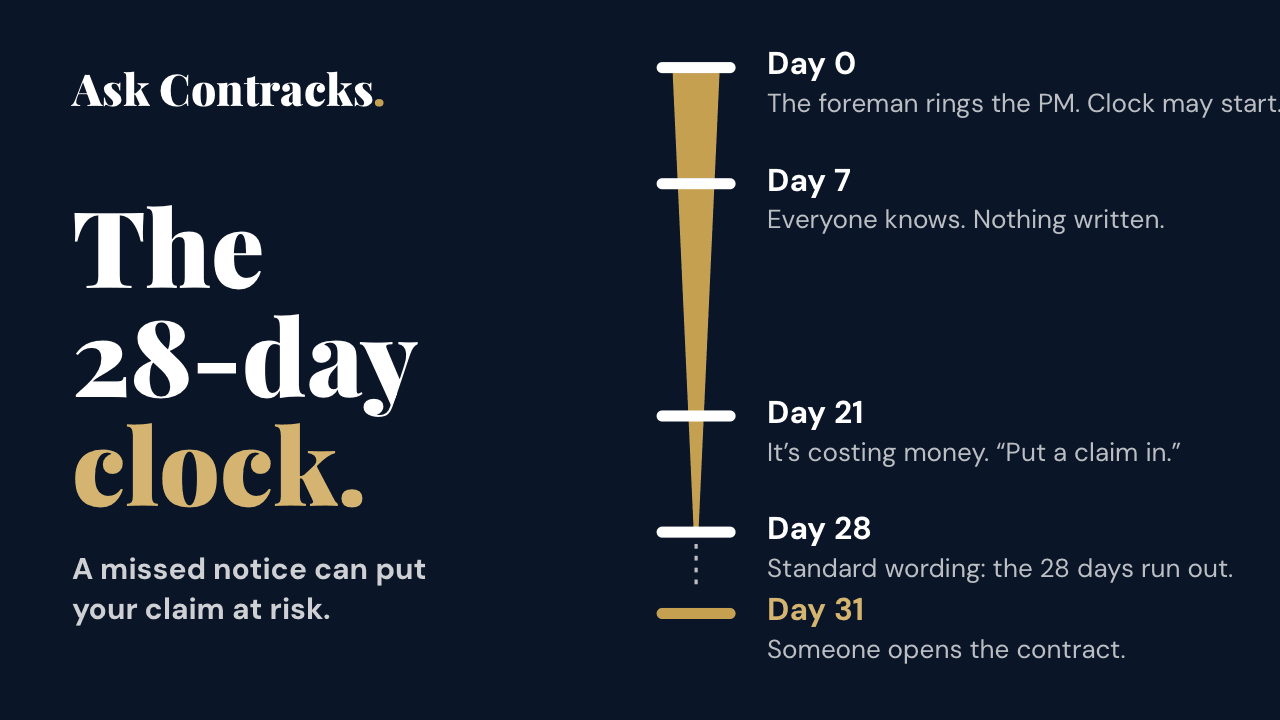
Day 31, and someone finally opens the contract
Access to the work front gets blocked on a Tuesday. Your foreman rings the project manager. The crew moves to something else, and the day carries on.
Everyone knows about it. It’s even in the site meeting minutes.
Three weeks later it’s costing real money, so someone says: we should put a claim in.
Another ten days go by before anyone opens the contract. By then it’s day 31.
The event was real. The cost was real. The notice never went out.
Now the first thing you’re arguing about is a date.
You’ve already paid the crew and carried the cost. What should have been a discussion about entitlement can now turn into an argument about whether the claim was notified in time.
That’s an illustration, not a case. You’ll still know the shape of it.
“We all know about it.”
Many experienced contract managers know the 28-day rule. Knowing the rule isn’t the same as controlling the date. The trouble starts when the date exists only in someone’s head.
It feels right because you’re on the job every day. Your best person knows the contract. The client was in the same meeting. Writing it all down feels like paperwork for its own sake.
It fails because everyone knowing doesn’t stop the clock. On the standard wording, it’s what starts it, often well before anyone says the word claim. Nothing on site tells day 27 from day 7. And the person holding the date is also trying to run the job.
It costs you the argument. At best, you spend your energy defending the notice instead of the entitlement. At worst, you lose the time and the money for that event.
What the clock actually says
Under the standard FIDIC 1999 forms, Sub-Clause 20.1 asks for your claim notice as soon as practicable, and not later than 28 days after you became aware of the event, or should have. The 2017 forms say much the same under Sub-Clause 20.2.1, where it’s called the Notice of Claim.
Three things in that wording catch people out.
It starts when you became aware, or should have. It doesn’t wait for the cost to be known, or for anyone to reply. “Should have” is the part to respect: what your foreman knew on that Tuesday may count.
On the standard wording, the notice describes the event. The detail comes later: a fully detailed claim, generally within 42 days under the 1999 forms and 84 days under 2017, counted from awareness rather than from the notice, unless another period is agreed. Under the 2017 forms, failing to state the contractual or legal basis in that period can also put the Notice of Claim at risk, subject to the contract’s procedures. “We’ll send it when we know the cost” is how good claims run out of days.
“As soon as practicable” comes first. Other procedures in your contract may ask for notice sooner. And if you’re a subcontractor, your own subcontract sets the period, which may be shorter, because the main contractor has to pass your notice up the chain.
What a late notice costs depends on your contract. The standard wording is hard: miss the period and you risk losing the extra time and money for that event. The 2017 forms add procedures for dealing with late notices, which gives you something to argue. I wouldn’t plan around it.
Editions, particular conditions and governing law all change the consequences. Particular conditions can substantially amend these clauses. Some governing laws can limit how far a time-bar is enforced. A missed step doesn’t always extinguish an entitlement, and a notice on time doesn’t prove one. So check your contract’s own clause, not my summary of the standard form.
The date has to come out of people’s heads and onto a page. In the 5Cs Framework™, this is CONTROL: deadlines and weekly review. The tool is dull, which is why it gets skipped: a notice register, with seven columns.
- The event, in one line.
- The date we became aware, and who did.
- The notice clause and period, from this contract.
- The last date for the notice, counted conservatively from the earliest awareness date you could reasonably be held to.
- One owner, by name.
- Date sent, how, and to whom.
- The next date: the detailed claim.
If it could cost time or money, it goes in straight away. An urgent notice decision gets escalated the same day. The weekly review checks what’s missing, who owns what, and what’s been chased. It never replaces what a contractual deadline requires.
The register only knows what it’s told. So ask site every week: what happened that we didn’t plan?
If you have no contract team
No department, no software. One register, one owner, reviewed weekly.
One register: a single spreadsheet per contract, with the notice period written at the top. One owner: a name, with the authority to chase site and get a letter signed. Reviewed weekly: a fixed slot, every week, whatever’s on fire.
Keep a short notice drafted and ready, so sending one isn’t a writing job on a Friday evening. Get it checked once against your contract’s requirements for notices, because a line in the minutes may not count, and the 2017 forms are stricter about what does.
If you already have an experienced team
Your contract manager probably has every date cold. That can be the reason nobody else does.
Then they take two weeks’ leave. Or they hand in their own notice. Ask yourself what happens to the log.
- Could a colleague run the register from the file alone for two weeks?
- Does every open item have a named deputy?
- When someone leaves, is the handover a document, or a chat in the car park?
None of this questions your team’s ability. It protects them, and the job, in the month when everything lands at once. We don’t replace your team’s judgement. We reinforce it.
The register isn’t the contract manager
A register can show you when a notice is due. It can’t decide whether an event creates an entitlement, how the notice should be framed, which evidence matters, or when something needs escalating.
That takes judgement, and judgement takes time. With no contract team, it falls on a project manager who’s already stretched. With a strong team, the hard part is keeping senior attention on it when the workload peaks.
This is where Ask Contracks fits. We’re senior contract managers who work alongside your project team and your counsel. We spot the exposure, protect your position commercially, and keep decisions moving. Your team keeps building. We help keep the contract under control.
Before Friday: one contract, one page
- Pick your most exposed live contract. Read its notice clause, particular conditions included, and write the period at the top of a page.
- Ask the project manager and the foreman one thing: what’s happened in the last eight weeks that could cost us time or money?
- Give each item an awareness date, the earliest you could reasonably be held to, and count forward.
- If a date is close, deal with it today. If one may have passed, talk to your contract lead or counsel before you write anything.
- Name one owner, and book the same slot next week.
The weekly review and same-day escalation are our recommended disciplines, not contractual deadlines.
“A notice will upset the client.”
I hear you. Nobody wants to be the contractor who sends a letter every time it rains.
But a notice can be short and factual. It says: this happened, it may affect time or cost, and we’re keeping our position open. It gives the other side a chance to act while acting is still cheap. It does have to meet your contract’s requirements for content, timing and delivery.
I’ve worked on the owner’s side as well. I’d take a short, factual notice on day 5 over a surprise in month nine.
So keep the tone flat, and speak to the client early, without holding up the formal notice. The call looks after the relationship. The notice looks after the date.
Two jobs, one lesson
Founder experience, before Ask Contracks — not results delivered by Ask Contracks.
As contract and commercial lead: six months of programme time lost to idle time were recovered within the original programme window. A €30M+ claims position was maintained. That’s a position kept open and supported, not money collected.
I led the commercial negotiation: a stalled FIDIC negotiation unlocked, and the relationship kept.
Neither came down to one notice, and your contract, your law and your facts will differ. What I took from both: a commercial position lasts as long as someone’s looking after it, on paper, by date.
You built it. You should get paid for it.
The deadline you miss may be the one you never tracked
A missed notice is one way to lose your grip on a contract. Unpriced changes, unrecorded delay, open instructions and payment cuts are others. What you need to know is which ones are putting your position at risk today.
The Contract Score takes four minutes. It scores the five controls of the 5Cs Framework™ and shows your two biggest gaps. Find your weakest control before it costs you.
Get my Contract Score — free →
Ask Contracks. Your contract team, without the hiring.
General information, not legal advice.
Next article — 4 December: Built it, never billed it.
Earlier: Contractors don’t go bust on site. They go bust on paper.